Get in touch with us at info@roarcollectivepk.com
In the spotlight
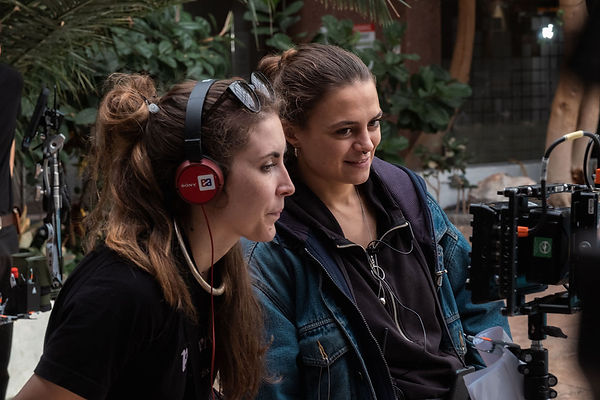
Carlotta is a London-based Italian filmmaker and artist whose work is rooted in observation, memory, and quiet curiosity. In this interview, she reflects on the worlds that shaped her, her instinct for storytelling, and the people and places that continue to influence her practice.

What’s your story, and how did your early life shape the filmmaker you’ve become?
I grew up in Northern Italy in the 1990s/00s. As an only child, I spent much of my time inventing stories and observing the lives of the adults around me. I was a quiet child - wide-eyed and deeply curious.
In many ways, I began storytelling early: hosting imaginary friends and once terrifying my mother when, at five years old, I opened the front door and calmly announced, “They’re coming in.” My world was populated by the creatures in my mind, the mountains that surrounded me, and the often eccentric but deeply kind people in my small town.
I was always drawing, always making things up. But over time, I realised that the most fantastical, hard-to-believe stories are often the ones unfolding in real life. That understanding continues to shape the way I approach filmmaking today.
When did filmmaking move from being a curiosity to something you knew you had to pursue seriously?
I’m not sure there was a single defining moment. I’ve always felt the need to find an outlet for the stories in my head, and as far back as I can remember, I knew I wanted to live and work in an artistic environment.
In Italy, at 14, you have to choose your type of high school. Because of my family, I enrolled in a classical studies programme, even though what I really wanted was to pursue the arts. In hindsight, I’m grateful for that experience - it introduced me to philosophical and political ideas I might not have encountered otherwise, and it shaped the way I think about the world.
As soon as I had the chance, after graduating, I enrolled at the Academy of Fine Arts. Even then, I didn’t know that cinema would become my path. It was through my studies that I gravitated toward video art and art direction for the screen. Gradually, I began directing my first films and videos - tentative and imperfect, but essential steps. Even now, I don’t see cinema as the end goal. It feels more like a tool - one of the ways I try to give form to the stories I carry.
Italy has such a rich cinematic tradition - what inspired your move to the UK, and how did that shift change your creative perspective?
I don’t think it was a cinema-driven decision. I was looking for a way to step outside my own normality - to explore the world and feed a curiosity that has always felt insatiable.
In my early twenties, I saw London as a place where art, political dissent, and creativity collided in a raw, anarchic way. I think I was drawn to that energy -
I wanted to challenge rules and push at the edges of my own creative identity.
Whether that’s exactly what I found is another story. But the move did create a rupture in my sense of self; it unsettled my certainties and forced me to re-evaluate who I was, both personally and creatively.
In that sense… it’s been a very punk experience!
Filmmaking has many moving parts. Which part of the process excites you most?
Of all its many beautiful parts, I keep coming back to the sense of community that filmmaking creates. Over the past ten years in London, working across projects for both the big and small screen, what I treasure most are the people: the collaborators, the friendships, the creative exchanges that end up shaping not just the work, but your life.
I also feel a strong connection to the analogue film community. I stumbled into it through straight 8, a brilliant competition I always recommend to all filmmakers and artists. You shoot a film on a single roll of Super 8, editing in-camera, with no sync sound or post-production - it’s for the brave, and it’s incredibly freeing.
What I love about London is how many spaces and people are keeping that analogue spirit alive.
From Cinelab and Kodak to realities like From the Silver Screen, there’s a shared commitment to preserving and celebrating the magic of shooting on film. It really does feel like an analogue renaissance.
Your work carries an intimate, observational quality. How much of yourself do you consciously bring into the stories you tell?
Some of my work is deeply rooted in my own experience, especially my latest narrative short, Dog Days, which follows a young girl at a swimming pool navigating peer pressure and her relationship with her own body.
More broadly, though, while I think it’s important to remain aware of one’s own point of view - and all its inherent biases - I’m very interested in exploring the stories of others. We live in a time that feels deeply focused on identity and self-narration. That can be a powerful tool for reclaiming space and reshaping discourse, but I also believe there’s great value in stepping beyond ourselves - engaging with perspectives we don’t fully know or understand, and allowing those encounters to expand us.
Much of my documentary work comes from that impulse. It focuses on the realities around me: from A Portrait, which tells the story of Christopher Hughes, cinematographer on Derek Jarman’s final films, to Your New Home, a collaboration with Bollo Brook Youth Club in Acton exploring gentrification and the life in the neighbourhood.
Are there films or any filmmakers that continue to inspire you, shaping the way you approach storytelling?
Alice Rohrwacher is a really inspirational filmmaker for me. I love her work and her delicate, intelligent, and playful gaze on the world. I would suggest that everyone add "La Chimera", "Happy as Lazzaro", and "Corpo Celeste" to their watching list.
Looking back, which of your projects feels like your strongest or most meaningful work, and why does it stand out?
Looking back, it’s difficult to single out one project, especially because each of my works feels very different from the last. However, if I had to choose, I would pick A Portrait. It was filmed in just one day and was a complete experiment.
I think it represents many of the things I’m drawn to, both on screen and beyond: biographical, character-driven storytelling shot on Super 8. It was probably the moment I fell in love with analogue filmmaking.
It also taught me a great deal - particularly about letting go of perfection and embracing how beautiful and valuable imperfections can be. It’s a small but powerful testament to cinema and art.
After being selected in the top 8 of straight 8 2020, it also led us on a very unexpected and wonderful festival run, during which I met many new friends and expanded my community in the UK. The Super 8 print of A Portrait is now preserved in the BFI National Archive.
If you hadn’t chosen the creative path, what might you have done instead?
I often joke with my husband that I should quit the industry and open a flower shop!
Thinking back, what advice would you give your younger self?
Don’t overthink it! I still do, to be honest.
Especially as women, but really as creators in general, we can get caught up in the idea of needing everything to be perfect: the right timing, the right resources, the perfect conditions to begin. But those conditions rarely exist.
The truth is, there’s no better film than the one that actually gets made.
As a filmmaker, what drives the stories you still feel compelled to tell, and what do you aspire to achieve next?
I’m very excited, as I’m currently developing a feature documentary to be shot in the Italian Alps this summer. I feel a strong urge to explore my roots, as well as more natural and simple ways of living and being in harmony with nature. The film will follow farmers who bring their cows to higher pastures for the summer, living apart from valley society, surrounded by nature and with minimal technology.
This project began as a gut feeling - a personal need to step off the accelerator of my London life, take a breath, and create in a more holistic and grounded way.
Over the past few years, I’ve had the immense pleasure of contributing to Super Nature (Doc Society, BFI), a feature documentary directed by Ed Sayers. Shot entirely on Super 8, the film explores wild species around the world through the work of different contributors. I filmed the segment on Alpine ibex. Since that experience I knew I wanted to return to the mountains - to portray and embrace the sense of freedom they offer.